Gemini 4 Argon Fact Check: What Google's New AI Really Does, What It Costs and Where It Loses
Last updated: October 21, 2026 · Leaderboards as of: Vals 19 Oct 2026, Arena 19 and 20 Oct 2026
Gemini 4 Argon is Google's new AI model, available to everyone since 13 October 2026. Google calls it number one. Checked on 21 October: third on the Vals Index, just behind two Claude models. First for text on Arena, tenth for building websites. In the Vals test it cost less than half as much as Claude Opus 5.5.
As of 21 October 2026. Leaderboards change constantly, prices change on 1 December 2026. Figures from Google are the manufacturer's own claims and are marked as such.
Contents
What is Gemini 4 Argon?
Google says its new AI model is number one. Depending on where you look, that is true. Or not quite. That is exactly what I looked into, source by source.
Gemini 4 Argon is the current flagship model from Google DeepMind. Google describes it as a model for real-world software engineering, knowledge work in law and finance, and cyber defense. For you as a business owner the middle part is the interesting one: contracts, reports, long documents, research.
When did Argon come out, and who can use it?
Google announced Argon on 30 September 2026. At first only selected security people got access, through the Fairwind Program, Google's own program for cyber defense. Since 13 October 2026 Argon has been available worldwide according to Google's launch post: for developers via the API in AI Studio, and for Google AI Pro and Ultra subscribers in the Gemini app and in AI Mode in Search.
Is Argon really a new model?
Yes. The Google DeepMind model card says Argon is 'not a modification or a fine-tune of a prior model'. So no warmed-up old model, but newly trained. Its knowledge goes up to March 2026. Anything that happened after that, Argon only knows if it searches the web or you give it the information.
One more detail from the model card that many articles get wrong: Argon outputs text, with up to one million tokens for input and output combined. According to the model card it can read text, images, audio and video. It can only produce text.
The video for this article, 5:14 minutes, in German. YouTube can auto-translate the subtitles. As of 21 October 2026.
What does Google claim about Gemini 4 Argon?
The central claim in Google's announcement: Argon is the leading model on the Vals Index. The launch post of 13 October says 'ranking #1 on the Vals Index'. In Google's own table Argon leads with 68.9 percent, ahead of Claude Opus 5.5 at 67.0 and GPT-6 Astra at 63.1 percent.
On top of that come best scores that Google measured and published itself. These are manufacturer claims. They may well be right, but that does not make them independently verified.
What does the Vals Index measure, and why should business owners care?
The Vals Index tests how well an AI handles real office work. Google describes it like this: it measures economic impact across finance, coding, legal and tax work, with every sector weighted by its contribution to U.S. GDP. For business owners that is a pretty good yardstick. It does not ask about puzzles or math olympiads, it asks about the work that actually piles up in a company.
What does Google say about long videos and legal work?
On long videos Argon leads, according to Google: 91.7 percent on LVBench, a test of whether an AI understands a long video. The competing models in Google's table score 79.7 to 87.5 percent.
On legal tasks Argon is far ahead in Google's table: 19.6 percent on the Legal Agent Benchmark from the legal software company Harvey, against 3.8 to 6.7 percent for the others. To be honest, the scores are still low across the board. Under 20 percent means it is nowhere near replacing your lawyer. On the Vals site Argon leads the Legal Research component with 54.81 percent.
Is Gemini 4 Argon really number one?
Short answer: at launch, yes. Today, not clearly. I opened the leaderboards myself on 21 October 2026. The picture is a neck-and-neck race, not a clear winner.
Where does Argon rank on the Vals Index?
On the Vals leaderboard, updated on 19 October 2026, Argon is in third place with 69.24 percent. Ahead are Claude Sonnet 5.5 with 70.85 and Claude Opus 5.5 with 70.18 percent, both from Anthropic. The gap: one to two percentage points. Vals itself gives a margin of error of around one point.

What is the Vals footnote about fallback models?
This is where it gets interesting. Vals adds a note itself: for the two Claude models, some tasks were answered by a fallback model after the provider refused. Counting those tasks as failures, Sonnet 5.5 drops to 69.03 and Opus 5.5 to 64.16 percent. In Vals' own words: 'Gemini 4 Argon had no fallbacks, so it would rank first.'
So both readings are on the same page. Officially third, first without fallbacks. In my view, anyone who writes 'number one' today should mention that footnote.
Where does Argon rank on Arena?
On Arena, users vote on which of two answers they prefer, without knowing which model wrote it. On the text leaderboard (as of 20 October 2026) Gemini 4 Argon is in first place with 1524 points, plus or minus 9. Arena marks the score as preliminary and shows a rank spread of one to three. Statistically, Argon is not clearly ahead of second and third place.
Building websites is a different story. On the WebDev leaderboard (as of 19 October 2026) Argon is in tenth place with 1678 points, rank spread eight to 16. At the top sits Claude Opus 5.5 with 1807 points.

| Leaderboard | What it measures | Argon's rank | As of |
|---|---|---|---|
| Vals Index | Office work: finance, law, tax, coding | 3 (69.24 %), 1 without fallbacks | 19 Oct 2026 |
| Arena Text | Users compare answers | 1 (1524 points, spread 1 to 3) | 20 Oct 2026 |
| Arena WebDev | Users compare built websites | 10 (1678 points, spread 8 to 16) | 19 Oct 2026 |
| Google's own table | Vals Index at launch | 1 (68.9 %) | October 2026 |
Where does Gemini 4 Argon lose?
The nice thing about Google's model card: it also shows where Argon falls behind. You just have to read the whole table, not only the rows in bold.
How does Argon do at coding in the terminal?
On Terminal-bench 4.0, a test of programming tasks on the command line, Claude Opus 5.5 wins with 66.4 to 57.4 percent. That is a nine-point gap, in Google's own table.
And on large software projects?
On FrontierSWE v2, GPT-6 Astra from OpenAI leads with 65.5 to 55.0 percent, a good ten points. Even Claude Opus 5.5 scores 62.3 percent here. Together with tenth place for building websites, the picture is clear: for coding, there are better options right now.
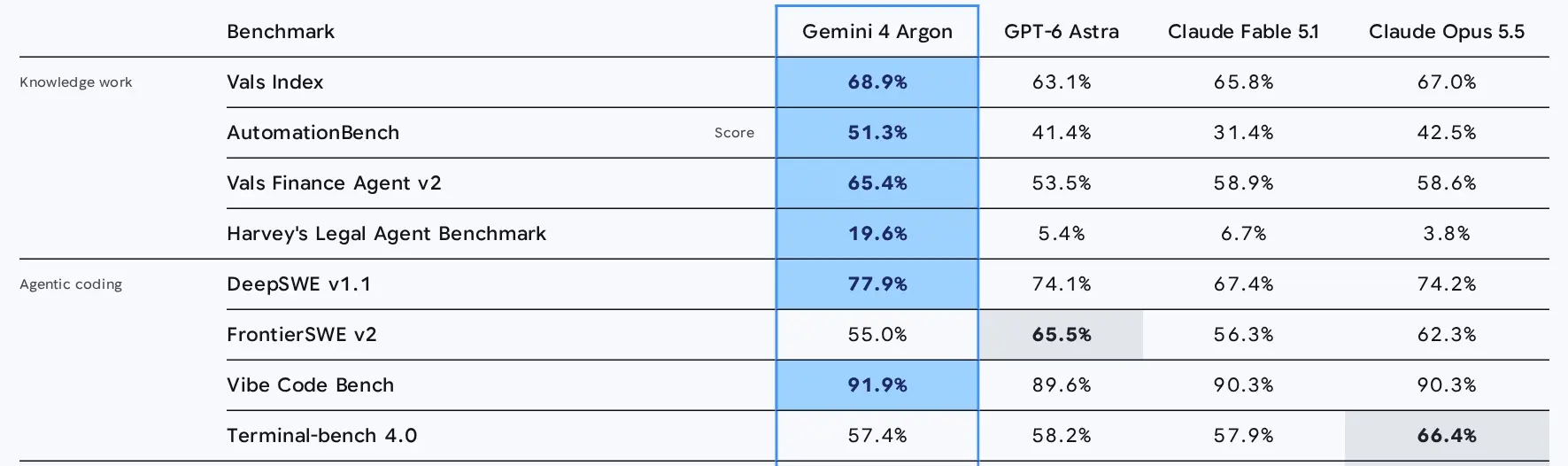
| Test (Google's table) | Gemini 4 Argon | Best competitor | Who leads? |
|---|---|---|---|
| Vals Index | 68.9 % | Claude Opus 5.5: 67.0 % | Argon |
| Harvey Legal Agent | 19.6 % | Claude Fable 5.1: 6.7 % | Argon |
| LVBench (long videos) | 91.7 % | GPT-6 Astra: 87.5 % | Argon |
| Terminal-bench 4.0 | 57.4 % | Claude Opus 5.5: 66.4 % | Claude Opus 5.5 |
| FrontierSWE v2 | 55.0 % | GPT-6 Astra: 65.5 % | GPT-6 Astra |
What that means to me: strong at analysis, research and long documents. For coding I would not reach for Argon by default today.
What does Gemini 4 Argon cost?
Now comes the most exciting part, really. On price, Argon plays to its strength. There are two routes: the API for developers, billed per token, and the Gemini app on a monthly plan.
What does Argon cost via the Gemini API?
According to Google's pricing page, until 30 November 2026 Argon costs 2 dollars per million tokens you send in and 10 dollars per million tokens that come out. From 1 December 2026 that doubles to 4 and 20 dollars.
What does a full test run cost by comparison?
The Vals leaderboard shows costs as well as scores. A full test run cost 13.37 dollars with Argon and 28.12 dollars with Claude Opus 5.5. Less than half. Argon was done after 44 minutes and 58 seconds, Opus needed 1 hour 25 minutes. Almost twice as fast.
Important for context: Vals already calculates Argon at 4 and 20 dollars, the price from December. So the cost advantage does not depend on the introductory discount.
| Model (Vals Index) | Score | Cost per test run | Duration |
|---|---|---|---|
| Claude Sonnet 5.5 | 70.85 % | $18.70 | 1 h 26 min |
| Claude Opus 5.5 | 70.18 % | $28.12 | 1 h 25 min |
| Gemini 4 Argon | 69.24 % | $13.37 | 44 min 58 s |
Source: vals.ai, Vals Index, as of 19 Oct 2026, opened on 21 Oct 2026.
What does Argon cost in the Gemini app in Germany?
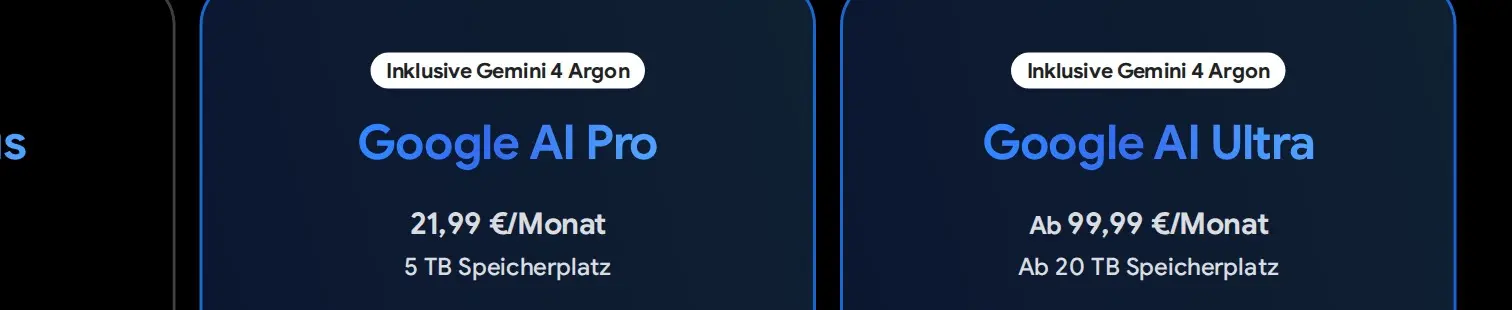
If you just want to use the app: in Germany, according to Google One, Argon is included in the Google AI Pro plan. That costs 21.99 euros a month. The large Ultra plan starts at 99.99 euros a month. Both plans carry the label 'Inklusive Gemini 4 Argon' (Gemini 4 Argon included) on the German page. I did not check prices for other countries.
Is there a free way to use Gemini 4 Argon?
No. The API pricing page says explicitly: 'Gemini 4 Argon is not available on the Free tier.' In the Gemini app, according to Google One, Argon comes with the paid Pro and Ultra plans.
What happens to your data when you use Gemini 4 Argon?
For the Gemini API, Google is clear. For the free tier the pricing page says 'Content used to improve our products', for the paid tier 'Content not used to improve our products'. In other words: what you send in for free, Google may use to improve its products. On the paid tier, according to Google, it does not.
Argon itself is only available on the paid tier anyway. But the rule applies to every other model you use for free via the API. So my advice: please do not just dump company data into some free tool.
One limitation, so nothing wrong sticks: this statement is on the API pricing page. The Gemini app has its own terms, which I did not check for this article. If your company uses AI, you should also know the obligations under the EU AI Act for businesses.
What does Google use Gemini 4 Argon for itself?
What I find really exciting is an example from Google's Antigravity blog. A team had 134 old bug reports lying around, spread across several services. Real legacy baggage. Argon used several agents to check which of them were still real, cross-referenced commit histories and checked whether fixes had actually reached production.
The result according to Google: in under three hours, 97 stale or duplicate reports were closed, each with documented proof. The remaining 37 were sorted by owner. That is Google's own claim, and of course I could not verify it.
But every business owner knows this. That pile nobody wants to touch. Old enquiries, open complaints, unread contracts. That is exactly where a model like this gets really interesting. What this looks like in my own day-to-day work is in my article about my own AI assistant.
Who is Gemini 4 Argon worth it for?
There is no single best AI. Depending on the task, sometimes Google leads, sometimes Anthropic, sometimes OpenAI. And it feels like that changes every week. Three weeks passed between Google's announcement and my check. In Google's table Argon is first on the Vals Index, on the Vals site it is now third.
When is Argon a good fit?
- Analysis and research: first for text on Arena, ahead in Google's knowledge-work tests.
- Long documents and videos: 91.7 percent on the long-video test, according to Google.
- Many tasks at a low price: in the Vals test run less than half the cost of Claude Opus 5.5, and almost twice as fast.
- Clearing backlogs: Google's own example with 134 bug reports shows what the model is built for.
When would I test a different model first?
For coding. Claude Opus 5.5 leads the terminal test, GPT-6 Astra leads FrontierSWE, and Argon is tenth for building websites. And for legal questions: scores under 20 percent make it a tool for groundwork, not a replacement for your lawyer.
How do you test Gemini 4 Argon for your business?
Leaderboards tell you how a model does on average. They do not tell you whether it does your work well. My tip from the video, step by step:
- Pick three real tasks. A report, a contract, a long email thread. Whatever is on your desk.
- Check your company data first. Only via paid access, and only what you are allowed to share.
- Run two or three models against each other. Same task, same instructions, for example Argon, Claude and GPT.
- Compare result and cost. Which answer would you pass on as it is, and what did it cost?
- Use the introductory price. Until 30 November 2026 Argon costs half of the later API price.
Then you will see for yourself what fits. How much work AI agents can already take off your hands is in AI agents for solo entrepreneurs.
Frequently asked questions about Gemini 4 Argon
What is Gemini 4 Argon?
+
Gemini 4 Argon is an AI model from Google. Announced on 30 September 2026, available to everyone since 13 October 2026. According to the model card it is newly trained, not a fine-tune of an earlier model. Its knowledge cutoff is March 2026.
Is Gemini 4 Argon the best AI model?
+
It depends on the leaderboard. On the Vals Index it ranked third on 19 October 2026, just behind Claude Sonnet 5.5 and Claude Opus 5.5. On Arena it ranked first for text and tenth for building websites.
Is Gemini 4 Argon free?
+
No. According to Google it is not available on the free tier of the Gemini API. In the Gemini app it comes with the paid Google AI Pro plan (21.99 euros a month in Germany) and Google AI Ultra (from 99.99 euros a month), as of 21 October 2026.
How much does the Gemini 4 Argon API cost?
+
Until 30 November 2026 Argon costs 2 dollars per million input tokens and 10 dollars per million output tokens. From 1 December 2026 it is 4 and 20 dollars. That is what Google's pricing page for the Gemini API says.
Is Gemini 4 Argon cheaper than Claude Opus 5.5?
+
On the Vals Index, yes. A full test run cost 13.37 dollars with Argon and 28.12 dollars with Claude Opus 5.5. Argon finished in 44 minutes, Opus needed 1 hour 25 minutes. Vals already uses Argon's later price of 4 and 20 dollars.
Can Gemini 4 Argon write code?
+
Yes, but it is not the best everywhere. In Google's own table Claude Opus 5.5 wins Terminal-bench 4.0 with 66.4 to 57.4 percent, and GPT-6 Astra leads FrontierSWE with 65.5 to 55.0 percent. On the Arena WebDev leaderboard Argon is tenth.
Does Google use my inputs to Gemini 4 Argon?
+
For the Gemini API Google says: on the free tier content is used to improve its products, on the paid tier it is not. Argon is only available on the paid tier. This statement does not automatically apply to the Gemini app, which has its own terms.
Can Gemini 4 Argon create videos?
+
Argon itself cannot. According to the model card it outputs text, with up to one million tokens for input and output combined. It can understand video well: Google reports 91.7 percent on LVBench, a test for long videos.
Which AI fits your business?
If you want to know how to put something like this to work in your company, with which model and for which tasks, let's talk.
Book a call
Gemini, Google AI Pro, Google AI Ultra and Antigravity are trademarks of Google LLC. Claude is a trademark of Anthropic, GPT a trademark of OpenAI. This article is not affiliated with any of these companies. As of 21 October 2026, leaderboards and prices change.
Sources
All pages opened and read on 21 October 2026.
- Google Blog, announcement of 30 Sep 2026 (Fairwind Program, Vals Index, LVBench, price 2 and 10 dollars): https://blog.google/innovation-and-ai/models-and-research/gemini-models/gemini-4-argon/
- Google Blog, general availability on 13 Oct 2026 ('ranking #1 on the Vals Index'): https://blog.google/innovation-and-ai/models-and-research/gemini-models/introducing-gemini-4-argon/
- Google DeepMind, Gemini 4 Argon model card (new model, knowledge cutoff, text-only output, benchmark table): https://deepmind.google/models/model-cards/gemini-4-argon/
- Vals Index, leaderboard, cost, duration and fallback footnote, as of 19 Oct 2026: https://www.vals.ai/benchmarks/vals_index
- Arena, text leaderboard, as of 20 Oct 2026: https://arena.ai/leaderboard/text
- Arena, WebDev leaderboard, as of 19 Oct 2026: https://arena.ai/leaderboard/code/webdev
- Gemini API, pricing and data use on the free and paid tiers: https://ai.google.dev/gemini-api/docs/pricing
- Google One, AI plans in Germany (Google AI Pro 21.99 euros, Ultra from 99.99 euros): https://one.google.com/about/google-ai-plans/
- Google Antigravity Blog, example with 134 bug reports (manufacturer claim): https://antigravity.google/blog/gemini-4-argon-in-google-antigravity