Last updated: May 2026
Water ingestion in a motorhome occurs when water enters the combustion chambers via the air intake and instantly destroys the engine. Repair costs range from EUR 5,000 to EUR 25,000. The crucial fact: water ingestion is a fully-comprehensive insurance claim - the insurer covers costs minus the excess. A puddle just 20 centimetres deep can be enough.
My Morelo Palace after water ingestion in Rostock - the ADAC mechanic assessing the damage
Table of Contents
- 1. The story: EUR 22,000 damage from a puddle in Rostock
- 2. Silver lining: what the repair uncovered
- 3. How water ingestion destroys your engine in milliseconds
- 4. How to recognise water ingestion
- 5. What to do immediately - and what not to do
- 6. The tip 99% don't know: water ingestion is fully-comp
- 7. What repairs cost - from EUR 500 to EUR 25,000
- 8. How to protect your motorhome from water ingestion
- 9. What I learned from EUR 22,000 of hard experience
- 10. Frequently asked questions
The Story: EUR 22,000 Damage from a Puddle in Rostock
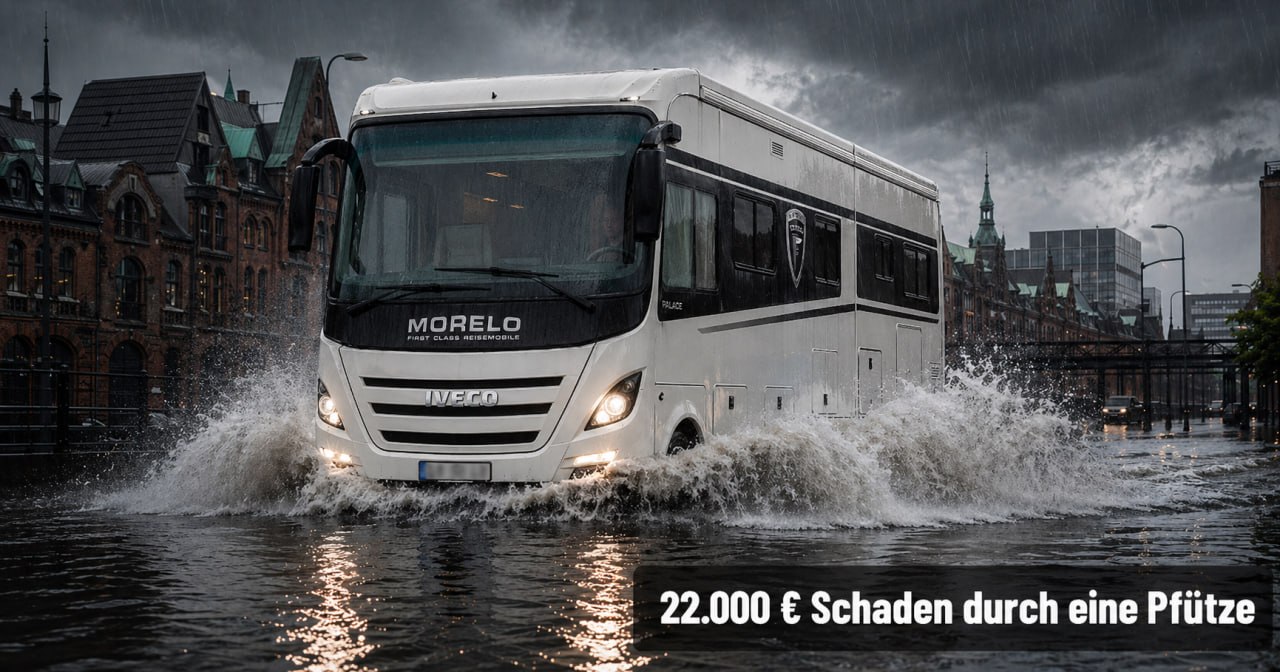
Rostock, a motorhome pitch, eight o'clock in the morning. We've just returned from a road trip to northern Sweden - three weeks at minus 35 degrees, northern lights, huskies, snowmobiles. The return trip by ferry from Stockholm, a hurricane on the Baltic Sea, six hours late. Now we're on this pitch, and in front of us is an enormous puddle.
The evening before, teenagers had been having fun driving their cars through the puddle. I say to my wife: 'We'll do that tomorrow too - wash the road salt off the underside while we're at it.' Next morning I drive in. Suddenly: vehicle off. Just dead. No spluttering, no warning - instant silence.
As a trained automotive mechanic I first thought of an electrical fault. But when I tried the starter and it barely turned, I knew: water ingestion. The water had entered the combustion chambers via the air intake - on my Morelo Palace on an Iveco base, positioned at wheel-hub height - and destroyed my engine in milliseconds. Through a puddle.
We were stranded in the middle of the water, couldn't move the vehicle. ADAC, friends, tow it out. Then the call to the workshop. Finding: complete engine replacement required. Cost: EUR 22,000.
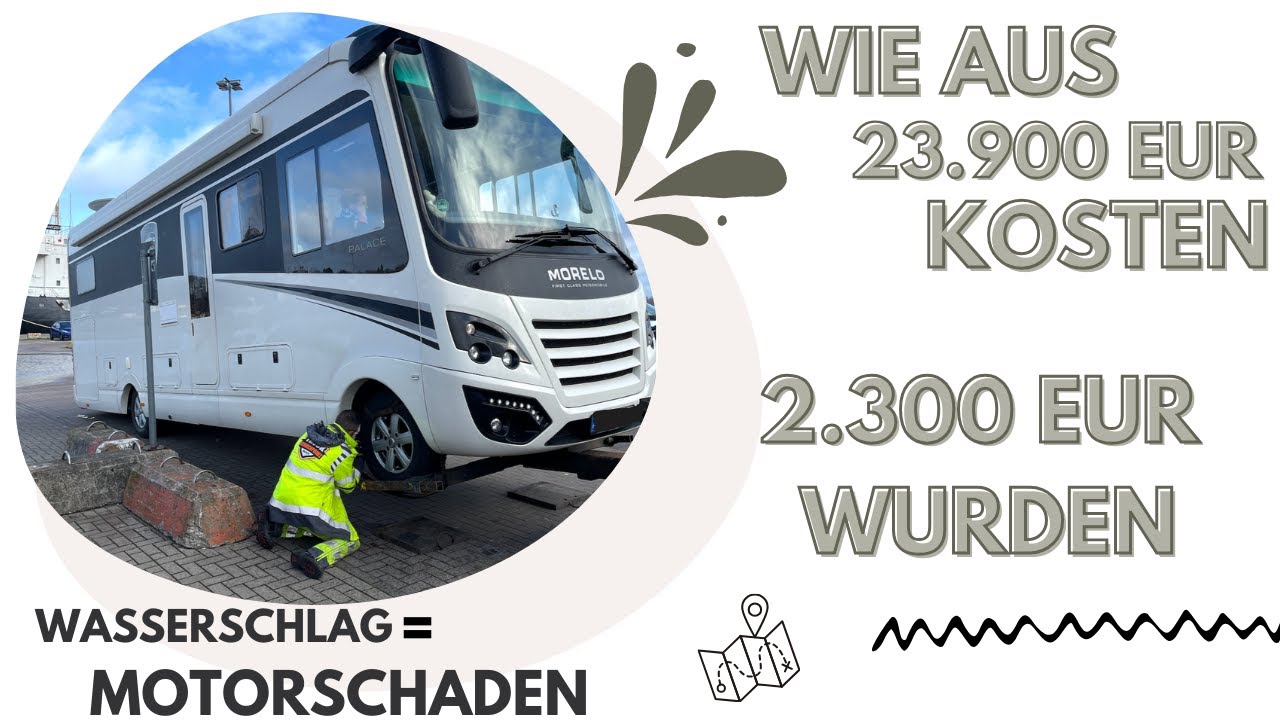
Video: The full story - from northern Sweden to EUR 22,000 in damage
Silver Lining: What the Repair Uncovered
EUR 22,000. For a puddle. Sounds like the worst day of my life as a motorhome owner. But it wasn't - and here the story gets wild.
First: water ingestion is a fully-comprehensive insurance claim. I didn't know that, my workshop didn't, the dealer didn't. But it is. The insurer covered over EUR 20,000. I only paid ten percent excess. More on that in Section 6.
Second - and this is the real madness: when dismantling the engine, the workshop discovered that my flywheel was already three-quarters cracked. A known issue on this Iveco build year that the manufacturer doesn't proactively address. Had the flywheel shattered at full speed on the Brenner Pass or a motorway, we'd have had a very different problem - one not about money but about safety.
The water ingestion in Rostock may have saved us from a far worse scenario. Sometimes a silver lining in misfortune is worth more than pure luck.
How Water Ingestion Destroys Your Engine in Milliseconds
The mechanism is physically simple - and that's what makes it so treacherous. Your engine draws air in via the intake, mixes it with fuel and compresses the mixture in the combustion chamber. When water is drawn in instead of air, the piston has a problem: water cannot be compressed. The enormous force has to go somewhere - and destroys the weakest components: connecting rods bend, valves break, in the worst case the piston punches through the cylinder wall.
In diesel engines - and most motorhomes run diesel - the risk is higher than in petrol engines, because diesel engines operate at significantly higher compression ratios. More pressure means more destruction.
Why motorhomes are particularly at risk
Motorhomes are based on van chassis with low-slung intakes - on my Morelo on an Iveco base, it sat at wheel-hub height, so 30 to 40 centimetres. Add to that the bow wave: a motorhome pushes a significantly higher wave ahead of it when driving through water than a car. The combination of a low intake and a high bow wave makes motorhomes the most vulnerable vehicles to water ingestion. A puddle just 20 centimetres deep can be pushed up to the intake by the bow wave.
| Damage Level | What Happens | Repair | Cost |
|---|---|---|---|
| Minor | Water in air filter, engine stalled | Replace air filter, dry spark plugs | EUR 200 - 500 |
| Medium | Bent connecting rods, valve damage | Engine overhaul, cylinder head | EUR 3,000 - 8,000 |
| Severe | Broken conrods, piston damage, cracked block | Complete engine replacement | EUR 8,000 - 18,000 |
| Total loss | Engine + gearbox + ancillaries destroyed | Engine + parts completely new | EUR 15,000 - 25,000+ |
How to Recognise Water Ingestion
The symptoms are unmistakable - if you know them. The engine dies abruptly. Not slowly, not spluttering, but instantly. One second it's running, the next it's dead. No starter sound when you try to start, no reaction. That distinguishes water ingestion from an electrical problem: with electrics, lights, radio and indicators usually still work. The starter may still turn. With water ingestion it doesn't - because the piston is pushing against the water.
Sometimes there's half a second of warning: a brief lurch or an unusual bang before the engine stops. If you feel the engine running roughly while driving through a puddle: lift off the throttle immediately. High revs at the point water enters means maximum damage. Low revs can be the difference between EUR 500 and EUR 22,000.
What to Do Immediately - and What Not to Do
The first few minutes determine how severe the damage will be. A single wrong move can turn a EUR 3,000 claim into a EUR 22,000 claim. The correct sequence:
- Do NOT start the engine. No starting attempts, no ignition on. Every rotation worsens the damage.
- Ignition off, key out.
- Hazard lights on, secure the vehicle.
- Call breakdown assistance. The vehicle needs to be towed.
- Notify your insurer. File a claim as soon as possible.
- Take photos. The puddle, vehicle position, water level - preserve evidence.
- Have the vehicle pulled out - don't roll it, don't push it with a gear engaged.
The most common and most expensive mistake: trying to start the engine in a panic. The starter pushes the piston against the water, bends the connecting rod, destroys the cylinder head. A single starting attempt can mean the difference between a repair and a write-off.
The Tip 99% Don't Know: Water Ingestion Is a Fully-Comp Claim
This saved me over EUR 20,000 - and almost nobody knows it. Not most motorhome owners, not many workshops, not even all dealers: water ingestion is a fully-comprehensive insurance claim. Not partial comp, not warranty, not goodwill - fully-comp.
In insurance terms, water ingestion falls under 'damage to the insured vehicle by external impact' - a standard fully-comprehensive provision. Many people think only collisions with other vehicles are fully-comp claims. Wrong. Driving through a puddle resulting in engine damage is also an insured event. In my case: over EUR 20,000 covered, I paid only ten percent excess.
| Scenario | Fully-Comp | Partial Comp |
|---|---|---|
| Driving through a puddle / water hole | Yes, covers | No |
| Flooding / inundation | Yes, covers | Yes (natural disaster) |
| Storm surge / heavy rain | Yes, covers | Yes (natural disaster) |
| Deliberate entry despite warning signs | Limited (gross negligence) | No |
How to file the claim: promptly and factually: drove through a water feature, engine cut out, no further start attempt. Attach photos. The insurer sends a loss adjuster. Important: no repairs before the adjuster. In my case the process from filing to payout took four weeks, the actual repair took ten weeks.
What Repairs Cost - From EUR 500 to EUR 25,000
The range is enormous. Minor water ingestion - engine switched off in time, only the air filter wet - costs EUR 200 to EUR 500. Medium damage with bent connecting rods: EUR 3,000 to EUR 8,000. A complete engine replacement like mine: EUR 15,000 to EUR 25,000.
On my Morelo it was exactly EUR 22,000: new engine, turbocharger, intercooler, flywheel. Add to that the time factor - eight to twelve weeks in the workshop is realistic. Mine took ten. Parts for rare chassis like Iveco Daily in a motorhome build take time. Ask specifically for workshops that know your chassis.
How to Protect Your Motorhome from Water Ingestion
Prevention is everything. Once it happens, the engine is gone. But with a few simple rules the risk can be reduced to almost zero. I wish I'd known this before Rostock.
- Never drive through water faster than walking pace. Speed creates a bow wave that can raise the water level in front of the vehicle by 20 to 30 centimetres.
- Check water depth first. If in doubt, get out and measure. No puddle is worth EUR 22,000.
- Know where your air intake is. Open the bonnet, follow the air filter hose to the intake opening. Note the height above the ground.
- Know your vehicle's wading depth. It's in the owner's manual. If not: ask the manufacturer.
- Don't follow behind other vehicles. Their bow wave raises the water level for you.
- If in doubt: turn around. Ten kilometres of detour beats ten weeks in the workshop.
Snorkel kits that relocate the intake to roof height are available for expedition vehicles. For standard motorhomes that's overkill - here knowledge and careful driving suffice. On newer models from 2023/2024, manufacturers have already positioned the intake higher from the factory. I now use my AI assistant to check weather conditions and route risks before every trip.
What I Learned from EUR 22,000 of Hard Experience
Over 25 years of motorhome experience. A background as a trained automotive mechanic. And still a puddle got me. If it can happen to me, it can happen to anyone. The difference between total loss and a narrow escape lies not in experience or driving skill - it lies in three things: knowing where your intake sits. Knowing that you never restart the engine. And knowing that fully-comp pays out.
My Morelo now has a completely new engine including a new flywheel - more reliable than before. And the trip to northern Sweden at minus 35 degrees, the northern lights, the huskies, the hurricane on the Baltic Sea, the water ingestion in Rostock - all together it's a story I'd never have experienced at a campsite in the south of France. The best stories are born where plans fall apart. I share exactly these kinds of stories on my YouTube channel too.
FAQ: Water Ingestion in Motorhomes
Is water ingestion in a motorhome covered by comprehensive insurance? +
Yes. Water ingestion is classified as a comprehensive (fully-comp) insurance claim. Comprehensive cover pays repair costs minus the agreed excess. Many motorhome owners - and even workshops - don't know this.
What does repairing water ingestion in a motorhome cost? +
Repair costs for water ingestion in a motorhome range from EUR 5,000 to EUR 25,000. A complete engine replacement including turbocharger, intercooler and flywheel can exceed EUR 22,000.
How does water ingestion happen in a motorhome? +
Water ingestion occurs when water enters the combustion chambers via the air intake. Since water is incompressible, connecting rods and valves bend. As little as 20 centimetres of water depth can suffice if the intake is positioned low.
How deep can a motorhome drive through water? +
The maximum wading depth depends on the position of the air intake. On intakes positioned at wheel-hub height, 20 to 30 centimetres is already critical. Newer models have the intake positioned higher. The owner's manual gives the exact wading depth.
What are the signs of water ingestion? +
Typical signs: engine cuts out abruptly, won't restart, unusual noises before stopping, water in the air filter housing. With these symptoms, never attempt to restart the engine.
Does third-party fire and theft insurance cover water ingestion? +
Third-party fire and theft (partial comprehensive) pays for water ingestion caused by flooding or rising water (natural disaster). If you drove into a puddle yourself, only fully-comprehensive applies. The distinction matters in each individual case.
How long does repair take after water ingestion? +
Repairing water damage to a motorhome takes between four and twelve weeks. A complete engine swap with ancillary parts replaced can realistically take eight to ten weeks. Parts availability determines the timeline.
Can I start the engine after water ingestion? +
No. Attempting to start the engine after water ingestion is the worst thing you can do. Every attempt worsens the damage considerably. Don't touch the engine, call a breakdown service, notify your insurer. That order matters.
Where is the air intake on a motorhome? +
The position varies by manufacturer and year. On older models like Morelo on an Iveco base, it sits at wheel-hub height. Newer models have the intake positioned higher in the engine bay. Check the owner's manual.
Is fully-comprehensive insurance worth it for a motorhome? +
Yes, especially for new vehicles and high-value motorhomes. Fully-comprehensive also covers own-fault damage such as water ingestion, hit-and-run damage and vandalism. For a motorhome costing over EUR 100,000, fully-comp makes economic sense.

Maik Schwede
Passionate motorhome traveller for over 25 years. Trained automotive mechanic, entrepreneur and sparring partner for 30+ years. Personally experienced the EUR 22,000 engine damage described here - on the return leg from a road trip to northern Sweden at minus 35 degrees.
Safe travels - and may your roads always be dry.
Maik